POVLY — Smart Glasses Creator Toolkit
Unlocking exclusive social media features for creators with 100% client-side EXIF metadata manipulation.
View Live System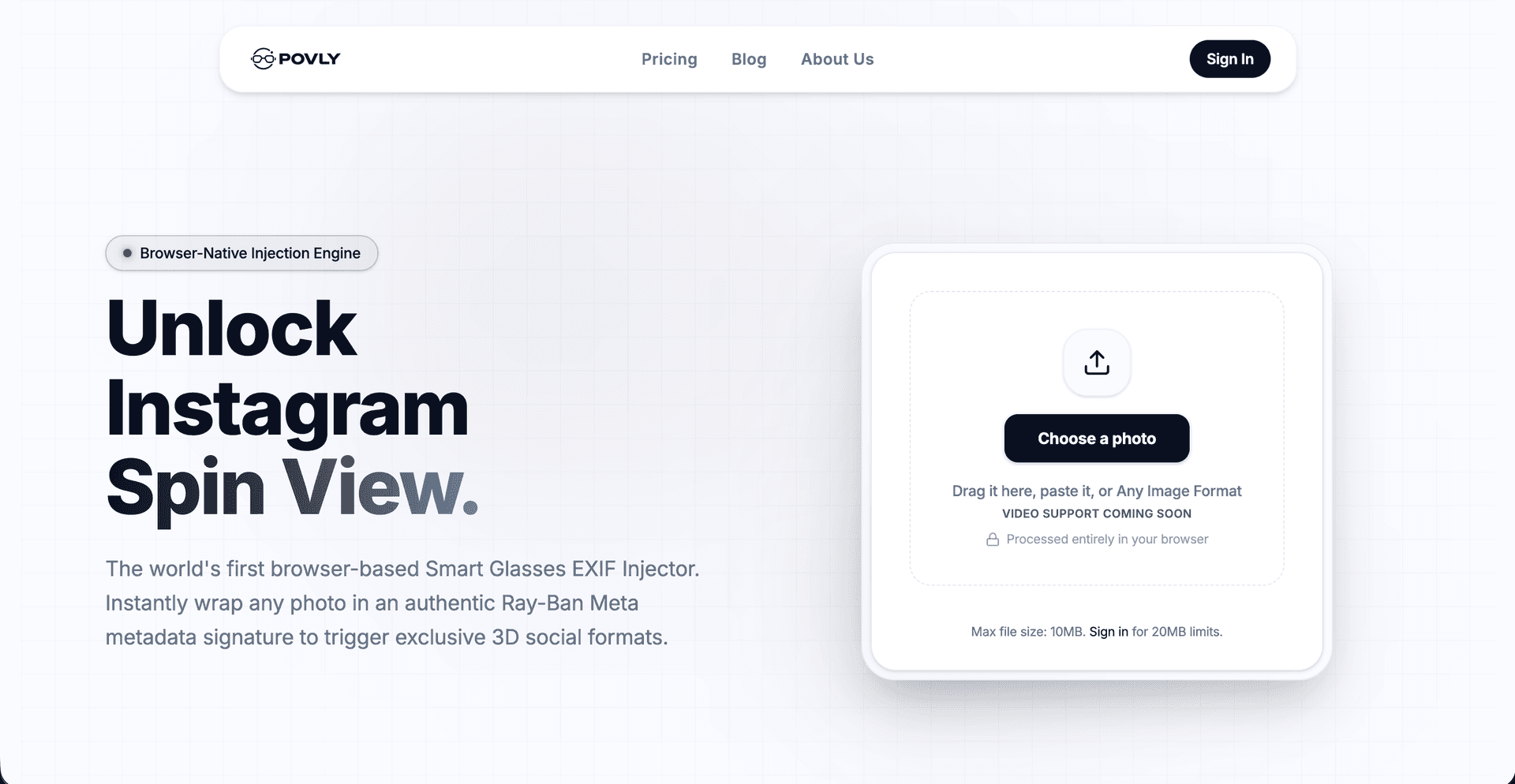
Technology Stack
Overview
Creators often want to use exclusive social media formats, like Instagram's "Spin View" or 3D panoramic photos, which are restricted to hardware like Meta Ray-Ban smart glasses. POVLY bridges this gap by allowing creators to inject the exact hardware footprint of genuine smart glasses into their standard photos.
Built as an independent SaaS product, POVLY ensures privacy and speed by processing all images locally on the user's device. No photos are uploaded to any server, making it a highly secure, privacy-first creator tool.
The Problem
Exclusive platform features locked to hardware: Social media platforms like Instagram reserve engaging formats (e.g., Spin View) for media shot on specific devices like Meta Ray-Ban glasses. Creators without this hardware cannot access these features.
Privacy concerns with image processing: Most online EXIF editors require users to upload their photos to a server, raising significant privacy and security concerns, especially for personal or unreleased creator content.
Complex metadata requirements: Injecting the correct signature requires accurately reconstructing the JPEG EXIF block to match different generations of smart glasses, a task too complex for standard metadata editors.
The Solution
100% Client-Side Processing:
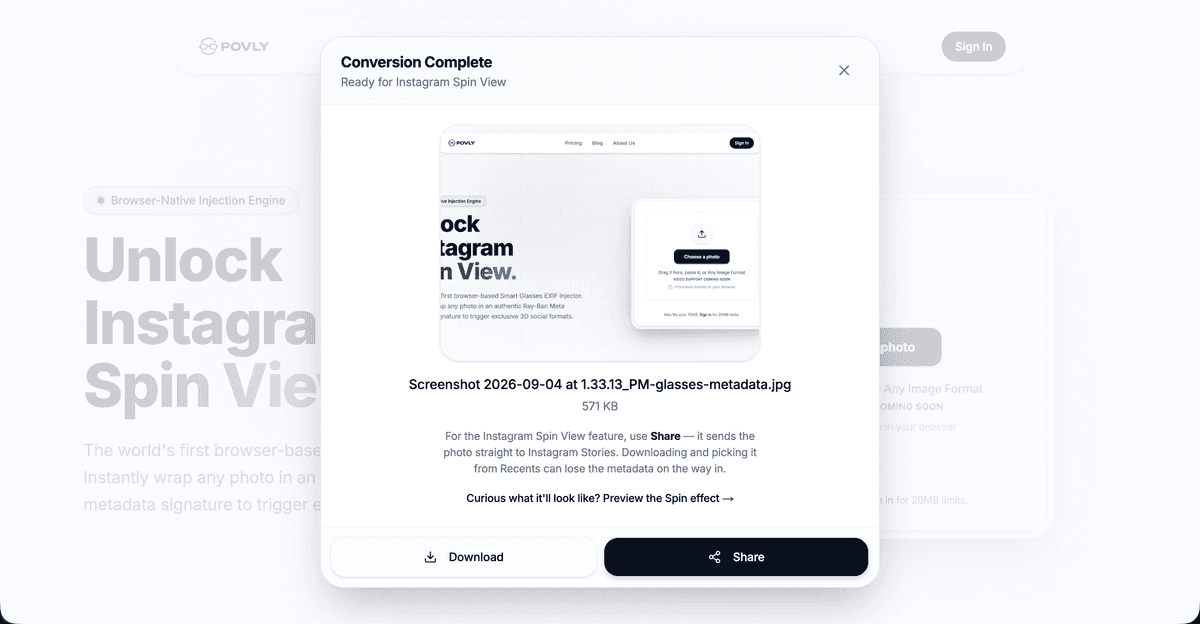
Built a robust in-browser processing engine using Web Workers, `createImageBitmap`, and `OffscreenCanvas`. The app parses, manipulates, and reconstructs the JPEG EXIF block directly on the user's device, ensuring zero server uploads.
Hardware Signature Injection:
Implemented multiple device profiles, allowing the tool to perfectly replicate the metadata signatures of various generations of smart glasses.
Freemium SaaS Model:
Integrated Supabase for authentication, allowing anonymous users limited usage, and Dodo Payments for seamless checkout and entitlement syncing for the Pro tier.
Viral SEO Strategy:
Developed a custom, statically generated MDX blog targeting high-intent search terms like "Instagram Spin View" to drive organic creator traffic.
Architecture
Frontend:
Next.js (App Router) combined with Tailwind CSS for a fast, responsive, and modern UI. Used Lucide React for iconography.
Image Processing Engine:
Offloaded heavy image manipulation to Web Workers to keep the main thread unblocked. Leveraged ExifReader and piexifjs for precise EXIF block reconstruction without backend dependencies.
Backend & Auth:
Supabase (PostgreSQL) handles secure authentication and tracks daily usage limits for free users.
Payments Integration:
Dodo Payments webhooks sync user entitlements in real-time, instantly unlocking Pro features upon successful checkout.
Key Implementation Details
- Engineered a 100% client-side EXIF manipulation pipeline using Web Workers
- Implemented accurate hardware profiles for multiple smart glasses generations
- Integrated Supabase Auth for freemium usage tracking
- Set up Dodo Payments with webhooks for secure Pro tier upgrades
- Built an SEO-optimized MDX blog to capture high-volume search traffic
- Designed a clean, utility-first UI with Tailwind CSS and Next.js App Router
Screenshots


Business Impact
- Empowered creators to access hardware-locked social media features without purchasing new devices
- Ensured 100% user privacy by eliminating server-side image uploads completely
- Established a scalable SaaS architecture ready for high-volume organic traffic
Key Engineering Challenge
The most significant technical hurdle was manipulating complex JPEG EXIF blocks entirely in the browser without crashing the main thread or running into memory limits on mobile devices. I solved this by moving the heavy parsing and reconstruction logic (using ExifReader and piexifjs) into a dedicated Web Worker and utilizing `OffscreenCanvas` and `createImageBitmap` for efficient memory management. Another challenge was perfectly mimicking the proprietary hardware signatures required by platforms like Instagram, which involved deep-diving into the EXIF specifications and testing multiple device profiles until the platforms accepted the injected metadata as authentic.